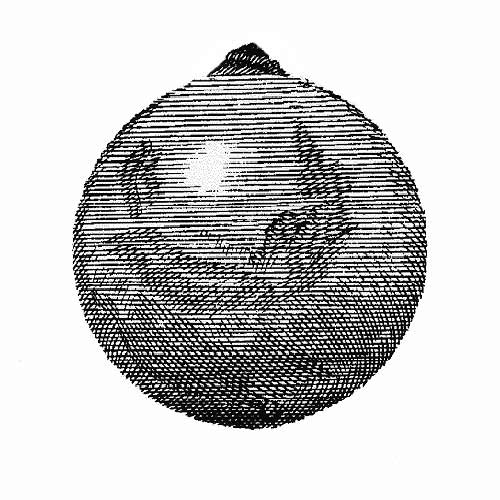
Newton’s canon
We illustrate here the concept of orbit through Isaac Newton's famous thought experiment and illustration of firing a projectile from
a high mountaintop at various speeds, as he described in
A Treatise of the System of the World.
We can observe that over a certain initial velocity, the projectile is able to make a
full orbit around the earth without falling back until it reaches its starting point again. In fact, if
this projectile were not thrown from the top of a mountain, but rather accelerated by a rocket during its
entire ascent, it would never reach the ground again and would "fall" back to Earth indefinitely.
In practice, various perturbative forces (the atmosphere, the inhomogeneity of the Earth's density, the solar
pressure, ...) cause the orbit of a satellite around a celestial body to vary slowly over time, sometimes
eventually causing the satellite to crash down into the ground.
We want to determine the speed at which the projectile is able to make a
full orbit, and the
speed at which it is on a
circular orbit:
Minimum velocity of orbitation
We want to determine the
minimal initial speed at which the canon ball is able to make a full orbit.
In this case, the trajectory of our projectile describes an ellipse with a minimum distance to the center of
the Earth equal to `R`, the Earth's orbit, this minimal distance is reached when the ball is halfway.
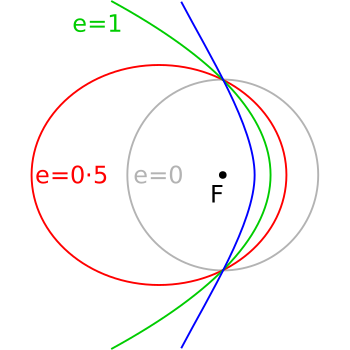
We measure the shape of a projectile's orbit around a celestial object using a parameter called
eccentricity,
denoted by `e\in[0, \infty[`.
- If `e = 0`, the orbit is a circle
- If `0 < e < 1`, the orbit is an ellipse
- If `e \geq 1`, the orbit is open.
Eccentricity of an orbit
We use the following definition to compute the eccentricity of an orbit using `r_{ap}` and `r_{per}`,
respectively the maximal and minimal distance to the celestial body our projectiles orbits.
`e = \frac{r_{ap} - r_{per}}{r_{ap} + r_{per}}.`
In our case, when the projectile is thrown from our mountaintop, and if it is just above the ground on the other
side of the earth, we have an eccentricity of:
`e = 0.0762124.`
Which means our orbit will be 'close' to a circular one.
Note that Newton's thought experiment is purely fictional and that in our calculations, the height of the mountain
is 16.5% of the Earth's radius (~1050 km), so the results we will obtain should be treated with caution in relation
to reality and are only here to give an intuition of orbital mechanics.
Now, we can use a formula derived from Kepler's laws of motion giving the velocity at the apogee
(the highest point on our orbit, in this case the mountaintop) as function of `e`. This velocity
will exactly correspond at the speed we have to give our projectile for it to complete a full orbit:
`v_{ap} = \sqrt{\frac{(1-e)\mathcal{G}M}{r_{ap}}}.`
For the Earth, `M = 5,9737 \times 10^{24} kg`, we deduce that:
`v_{ap} = 7043.49` m/s.
Which you can verify if not done already in the simulation above.
Velocity of circular orbitation
Let `P_1`, `P_2` be two mass points of respective masses `M`, `m`.
Newton's law of gravitation gives the value of the attractive force between `P_1` and `P_2` :
`F = \mathcal{G}\frac{Mm}{d^2}`
where:
- `d` is the distance between `P_1` and `P_2`
- `\mathcal{G}\approx6.674\times10^{-11} m^3.kg^{-1}.s^{-2}` is the universal gravitational constant.
Thus, the acceleration of point `P_2` towards `P_1` is:
`a = \mathcal{G}\frac{M}{d^2}.`
The object is in circular orbit when it is always at distance `d` of the Earth's center.
For a circular motion, the acceleration is normal to the satellite's velocity and if `V` is the tangential
orbital speed:
`a = V^2/d.`
Thus, the circularization speed `V_{c}` of our projectile verifies:
`\mathcal{G}\frac{M}{d^2} = V_{c}^2/d`
and finally
`V_{c} = \sqrt{\frac{\mathcal{G}M}{d}}.`
Hence the circularization speed:
`V_{c} = 7329.05` m/s.
Based on an idea by Daniel V. Schroeder.